Перейти к контенту
SVOZIM Туры
What to seeReviewsBook
Transfers Tourism For Companies For Schools
РУС ҚАЗ ENG
Message on WhatsApp
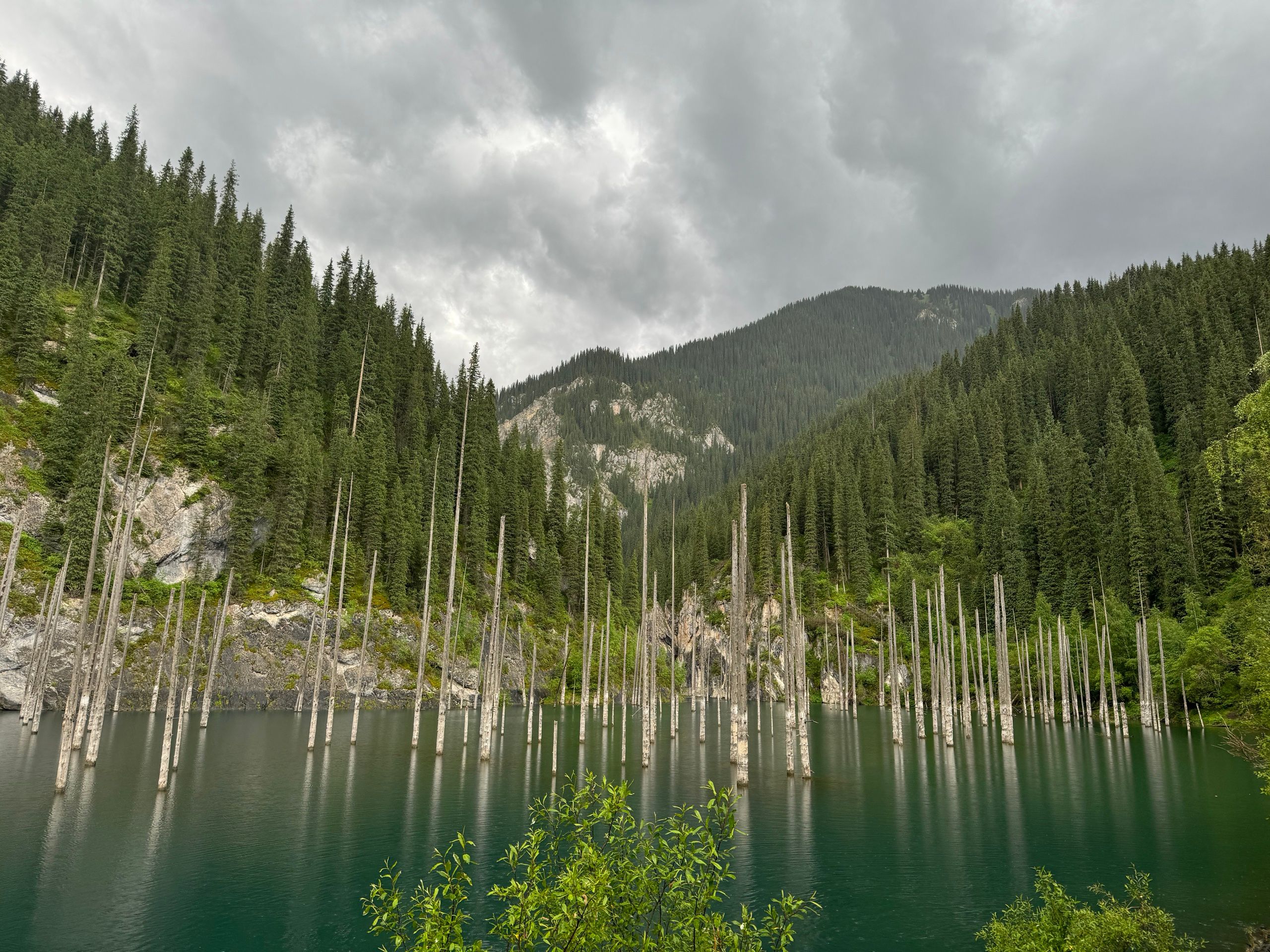
Schrenk spruce trunks rising from the turquoise water of Lake Kaindy
2-day trip from Almaty

Lake Kaindy

"The sunken forest" — Schrenk spruce trunks that have stood above the surface of a mountain lake for over a century

Distance
280 km
from Almaty
Elevation
2,000 m
above sea level
Depth
30 m
at deepest point
From
110,000 KZT
per minibus up to 14 pax

What Kaindy is

Kaindy is a small but world-famous lake inside Kolsai Lakes National Park, 280 km east of Almaty. About 400 m long, 30 m deep, sitting at 2,000 m elevation. The standout feature: bare tree trunks rising from the water like the masts of a sunken fleet.

These trees are Schrenk's spruce (Picea schrenkiana), not birches. The paradox: "Kaindy" in Kazakh means "rich in birches" — but the name refers to birches in the surrounding gorge, not to the submerged forest itself.

The trunks have stood for over a century because the lake water sits at 4–6°C year-round — mineral-rich, very cold, and unfit for wood-decaying microbes. So the spruce forest that drowned in 1911 has remained almost intact. The lake is famous worldwide for ice diving — winter visibility exceeds 25 metres.

What you'll see

Kaindy isn't one shot — it's a place that looks completely different depending on light and season.

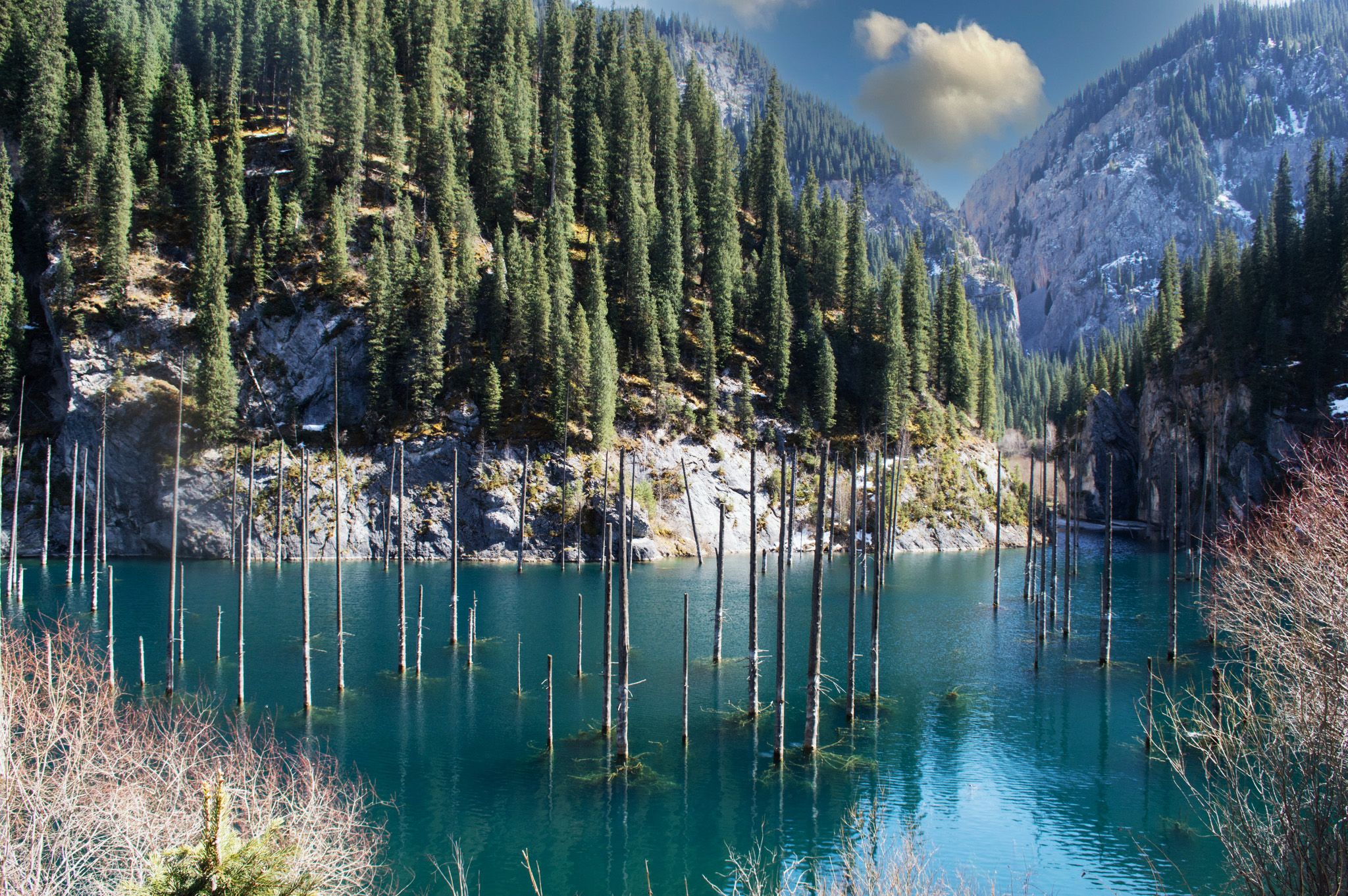
Bare Schrenk's spruce trunks rising from Lake Kaindy

The sunken forest

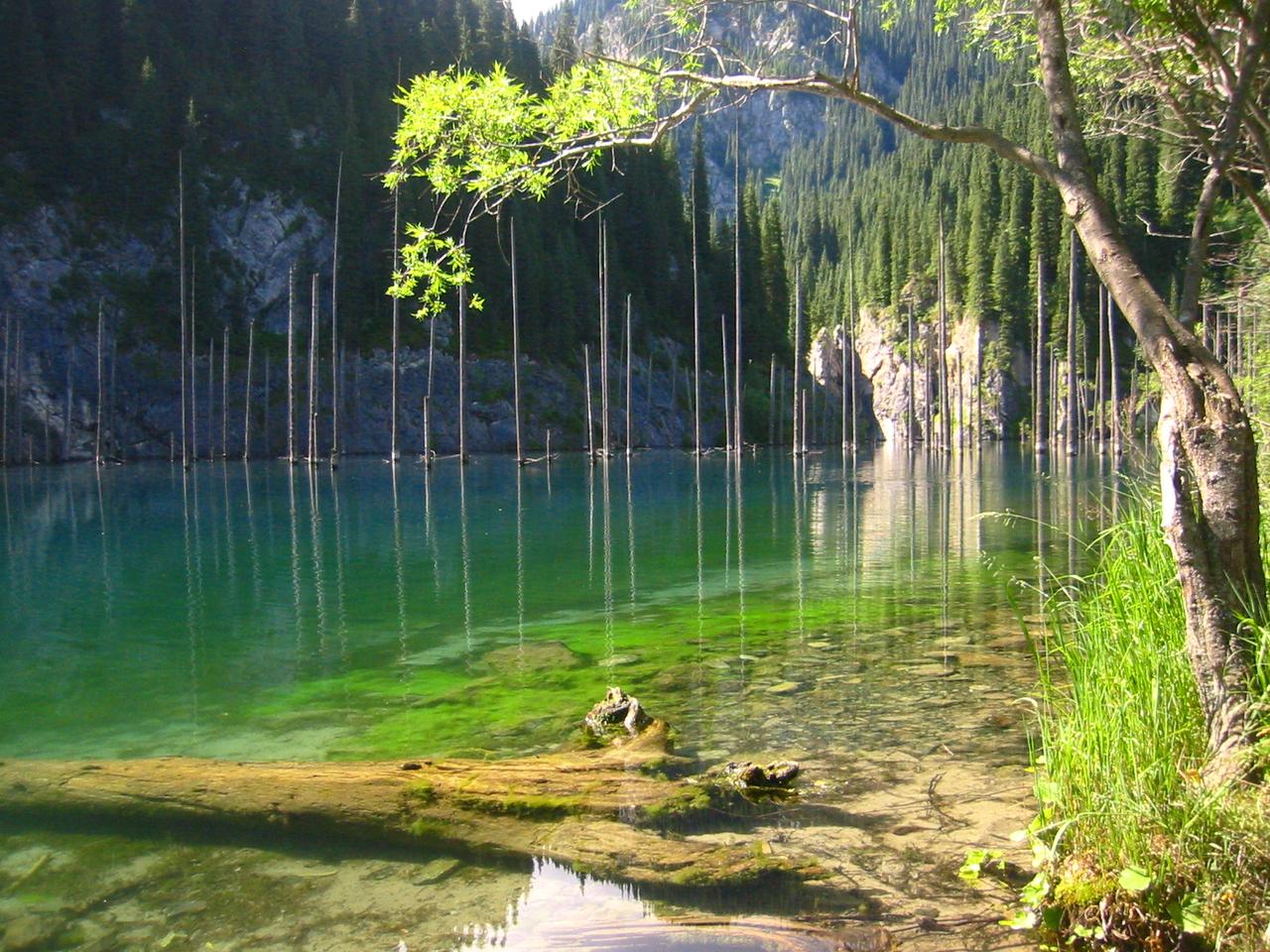
The lake's headline feature — bare Schrenk spruce trunks rising straight out of the water. From far away, they look like ship masts; up close, like the ruins of a flooded city. Look into the clear water and you'll see the lower part of the trunks, sometimes old branches, still preserved.

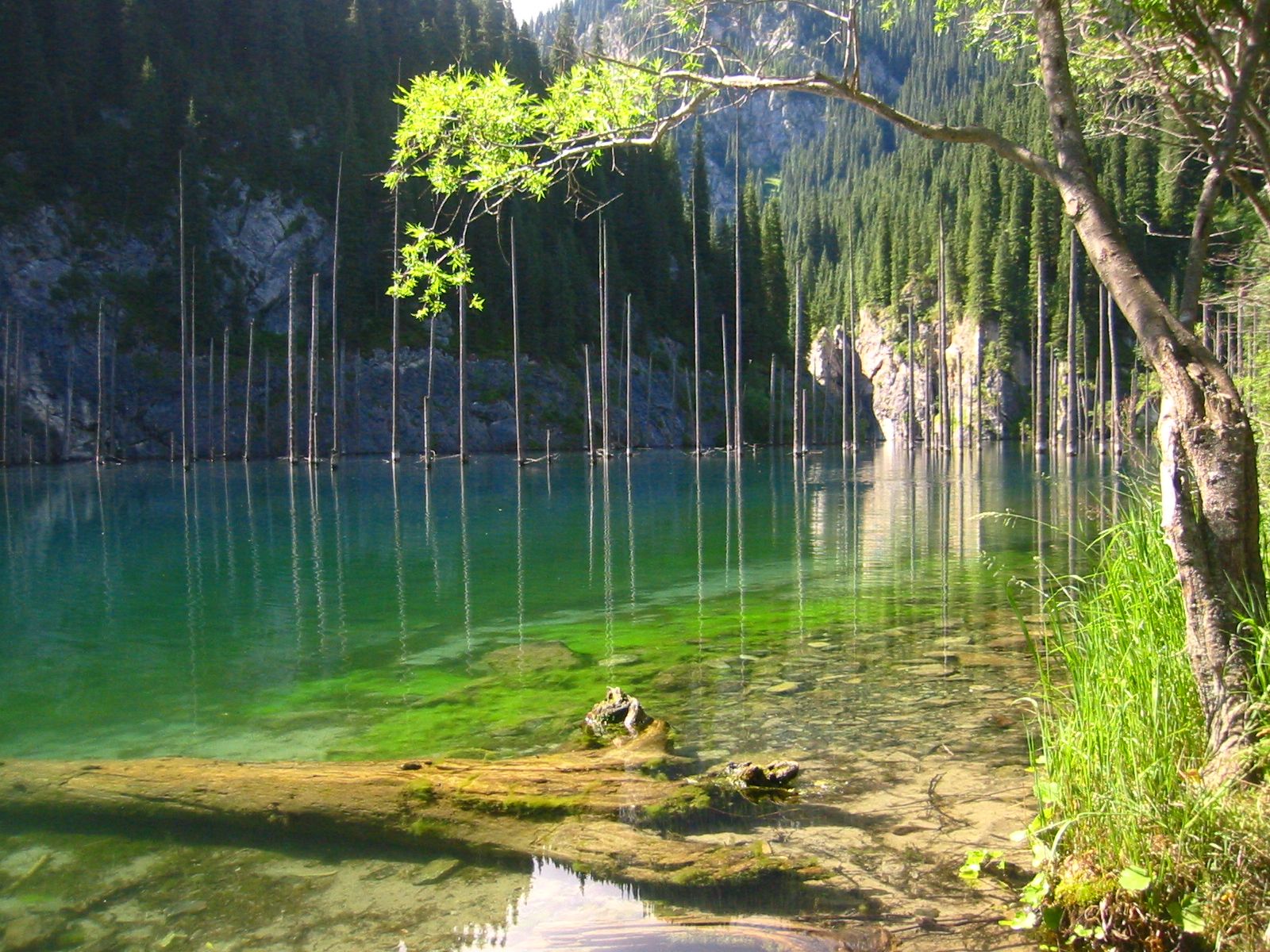
Turquoise water and spruce trunks of Lake Kaindy

Turquoise-green water

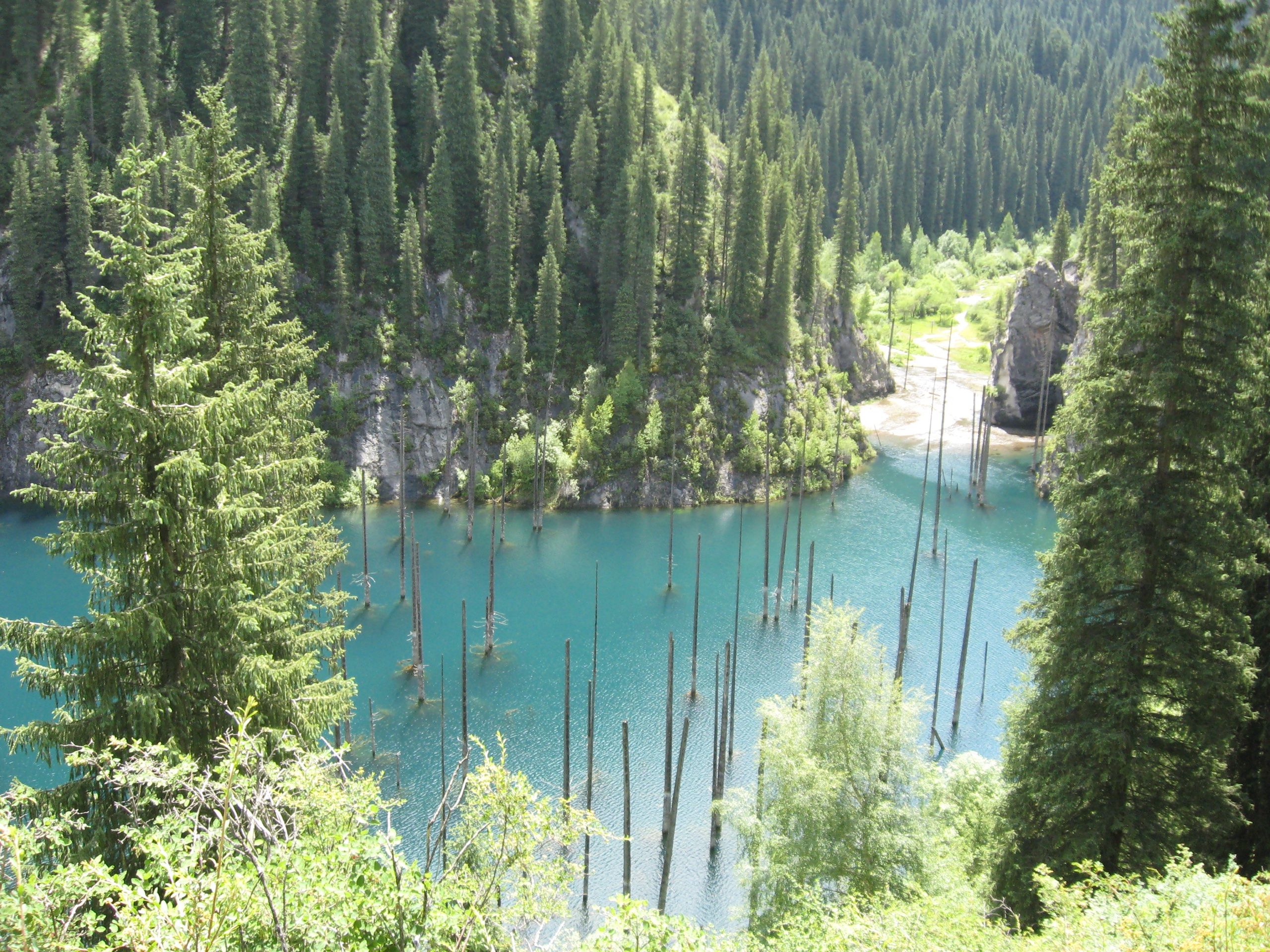
The lake's unusual turquoise color comes from dissolved minerals from the limestone landslide. In sunlight the water almost glows, turning the trunks into the foreground of a surreal painting. On windless mornings the lake becomes a mirror — trees doubled in perfect reflection.

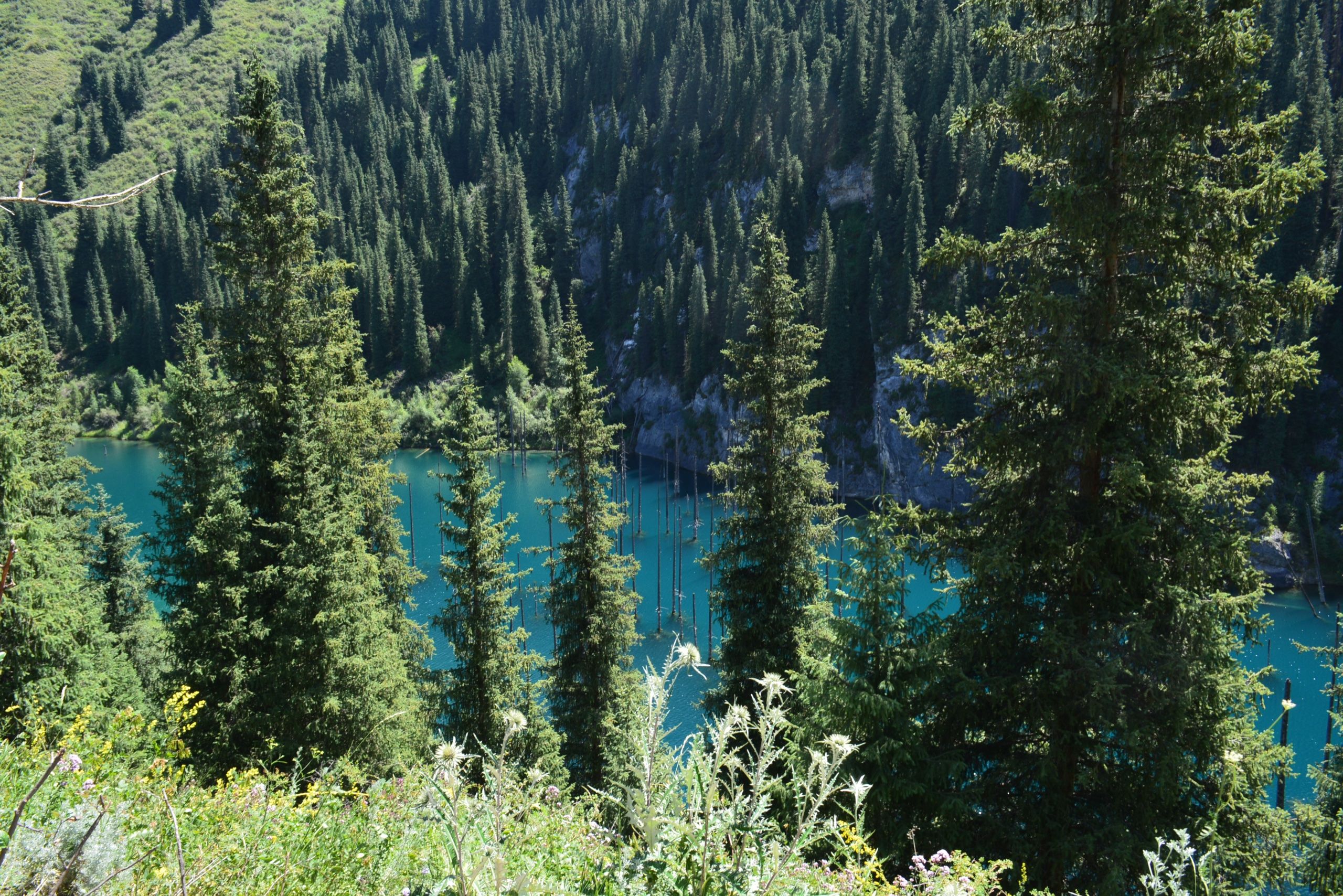
Aerial view of Lake Kaindy

View from above

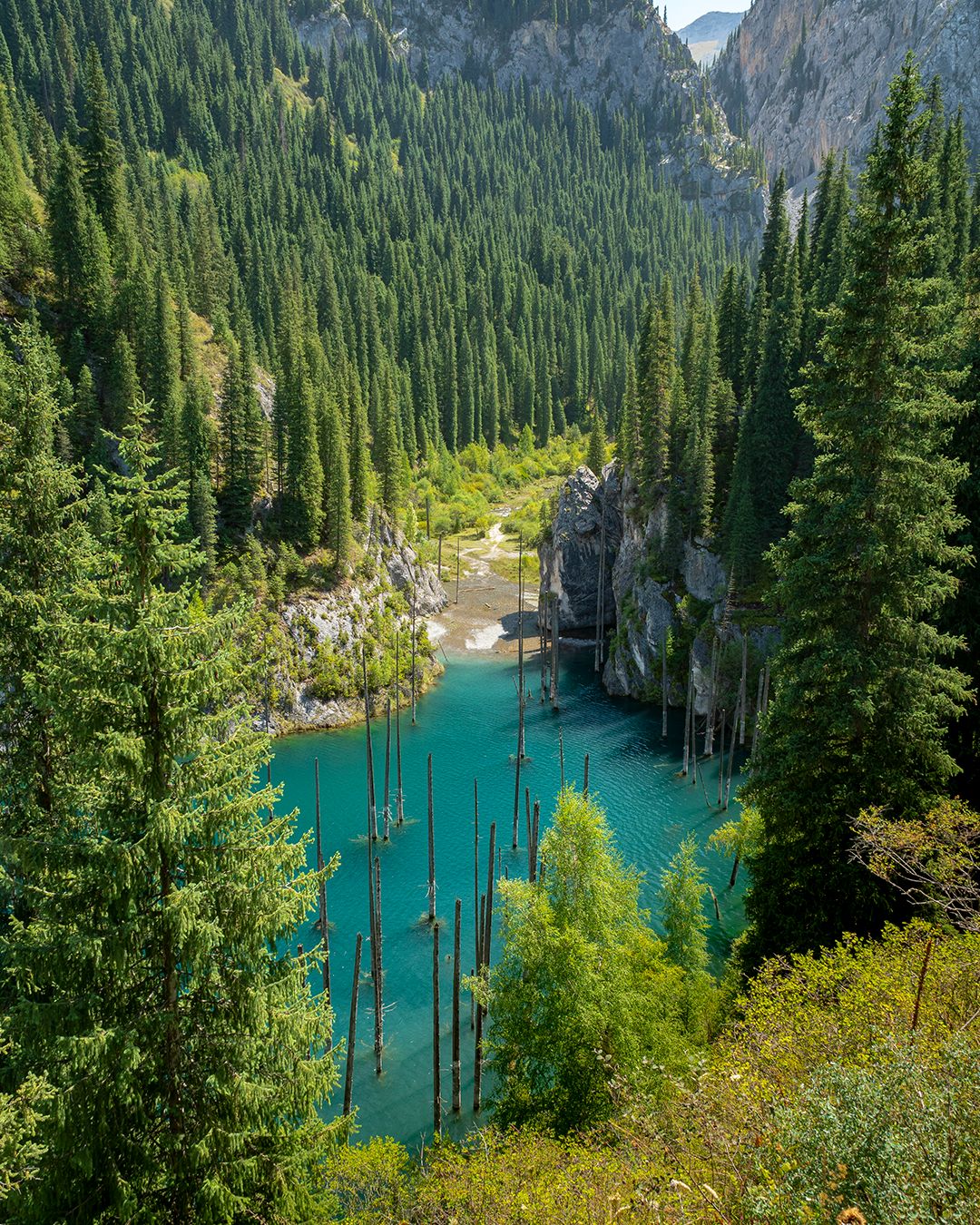
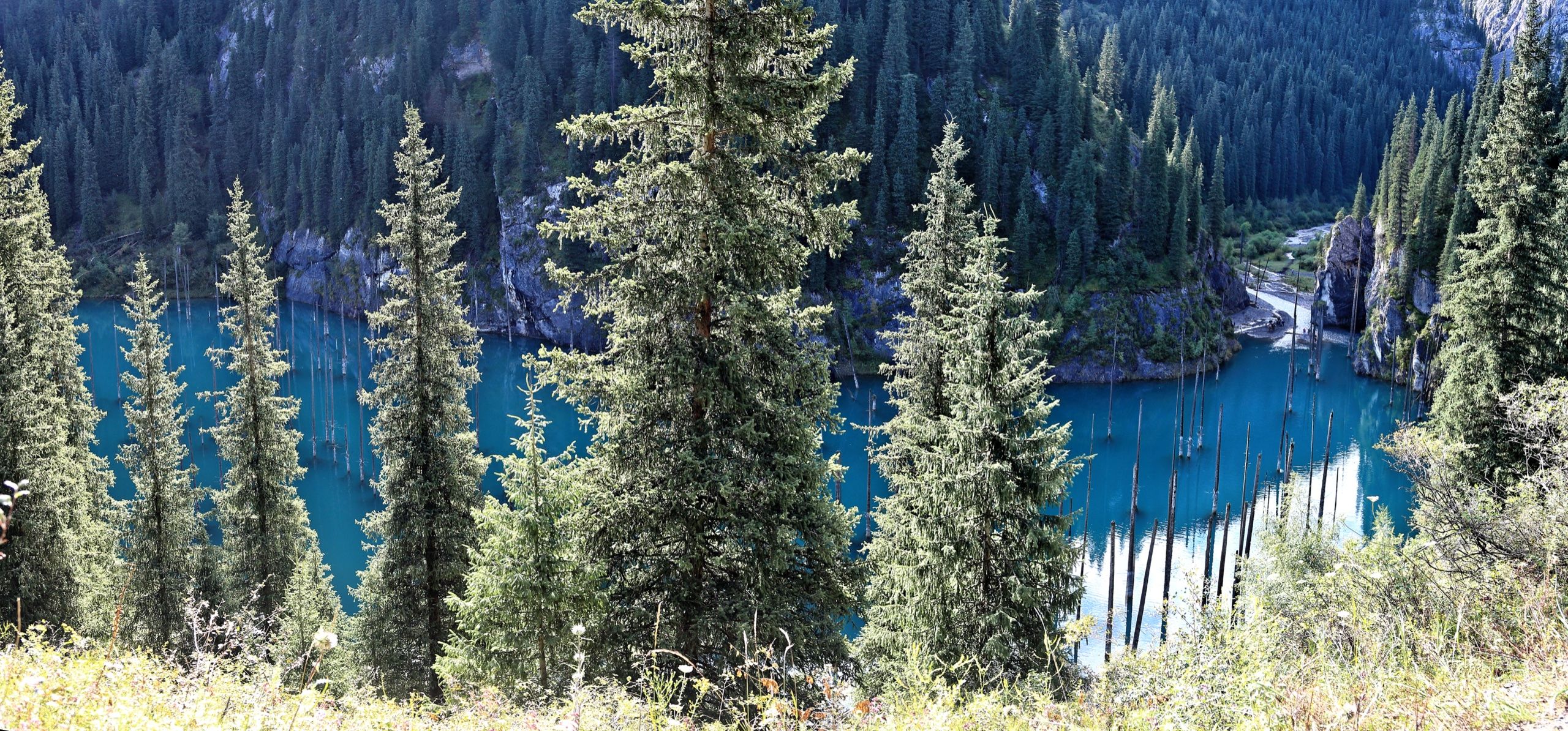
From the upper parking and the new wooden viewing platform you get the full panorama. The trees line up like a geometric pattern; the turquoise water has an almost unnatural shape. From a drone (with park permission) the view is even more striking — you see the entire structure of the drowned forest.

Lake Kaindy in spring with snow-covered slopes

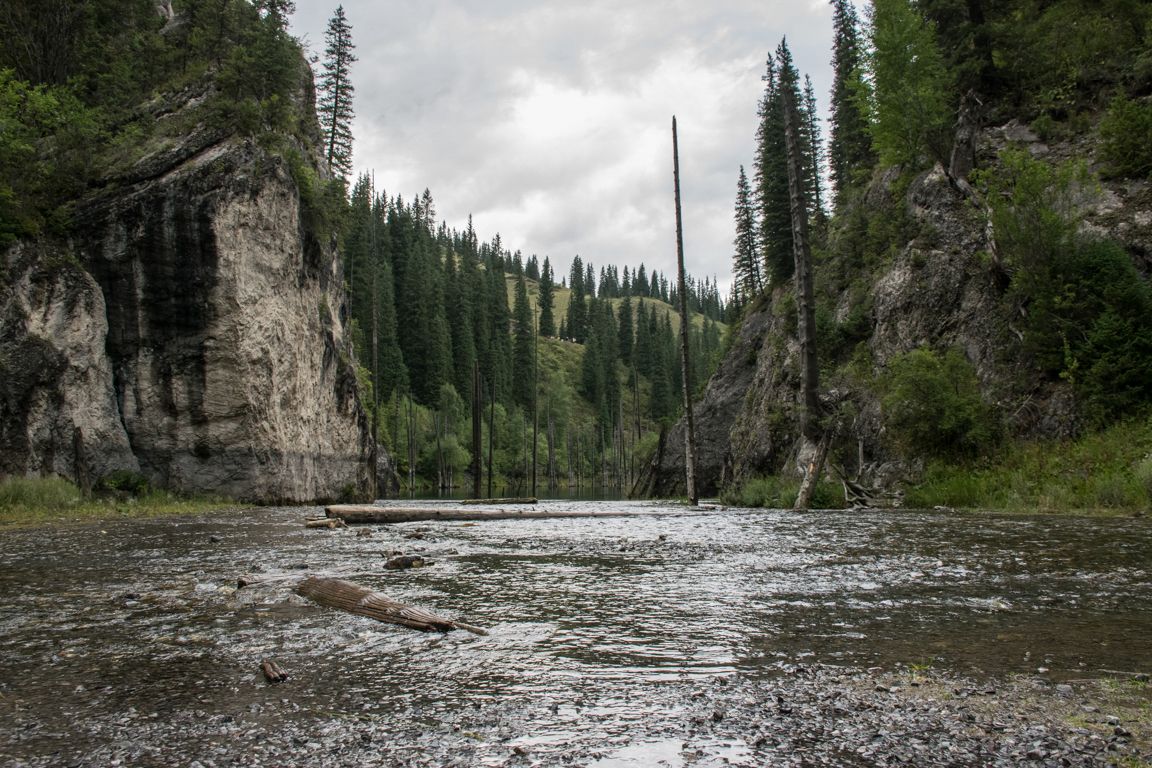
The surrounding gorge

Kaindy isn't an isolated object — it's a mirror in the bottom of a narrow gorge. Around it: steep mountain slopes, real birch groves (hence the name), and a coniferous forest. In autumn the birches turn gold and contrast spectacularly with the turquoise water — photographers wait for that week in silence.

Why it's worth the trip

1

There's nothing else like it

A handful of places on Earth have a sunken-but-preserved forest. Kaindy has been featured by Atlas Obscura, National Geographic, and Discovery as one of the rarest natural sights anywhere.

2

Pairs with Kolsai in one trip

Kaindy and Kolsai sit in the same national park, 30 km apart. With one night in Saty you can see both lakes in a single day.

3

Ice-diving season

In winter the lake freezes; underneath, crystal-clear water and a century-old forest. One of the world's most striking ice-diving sites.

4

A photographer's lake

Morning stillness, midday turquoise, evening gold — Kaindy lets you shoot three completely different scenes in a single day.

Free quote

Book a Lake Kaindy tour

Send a request — our manager replies on WhatsApp within 15 min with the exact price and available dates.

By clicking Send you agree to the processing of personal data.

— or —
Message us on WhatsApp now

What travelers say about Kaindy

Real reviews from TripAdvisor.

4.7 · 6 reviews
«This is perhaps one of the most beautiful lakes I have visited thus far. The yellow shades of early autumn make the entire lake extra magical and mesmerizing!»
Q
Quzc0
Malaysia · September 2025
via TripAdvisor →
«After a rough four-wheel drive and nostalgic minibus from the parking lot to the lake area, we were so amazed by the pine trees in the lake.»
s
steelriver2014
Munich, Germany · May 2025
via TripAdvisor →
«Kaindy Lake is one of the most enchanting, beautiful and enigmatic lakes I've been to in my whole life.»
MP
Maricel P
Abu Dhabi, UAE · November 2024
via TripAdvisor →
«The icy waters have preserved the submerged pine trees, giving a surreal and haunting atmosphere to the entire lake.»
B
Bozeman-Dublin
Trim, Ireland · August 2024
via TripAdvisor →
«The water in the lake is a striking blue-green color, which contrasts beautifully with the dark green conifers.»
R
Raintree_Thailand
Bangkok, Thailand · October 2024
via TripAdvisor →
«High clearance is a must, but no 4×4 needed in August. We drove a Subaru Outback over the 30–40 minute off-road from Saty with no trouble.»
m
mrc282
World · August 2024
via TripAdvisor →

Photo gallery

Real photos of Kaindy — from Wikimedia Commons, no edits.

Lake Kaindy on a cloudy day Lake Kaindy in summer Lake Kaindy seen from above Panorama of the sunken forest at Lake Kaindy Turquoise water and spruce trunks of Lake Kaindy Lake Kaindy in spring with snowy slopes

All photos are licensed on Wikimedia Commons:

Jonas Satkauskas — Attribution (kaindy-classic)

Katariyakartikey — CC0 (kaindy-cloudy)

Anna Powaska — CC BY-SA 4.0 (kaindy-spring)

Yakov Vassilyev — CC BY-SA 4.0 (kaindy-panorama)

PictureRost — CC BY-SA 4.0 (kaindy-shore)

Guldariya Baimukhanova — CC BY-SA 4.0 (kaindy-aerial)

Dots foto — CC BY-SA 4.0 (kaindy-from-height)

Alfira Khissamutdin — CC BY-SA 4.0 (kaindy-summer)

History and notable facts

On 3 January 1911 the Kemin earthquake (M ~8.0) shook the Chon-Kemin valley. Surface ruptures stretched 200 km, and 452 people died in Verny (modern Almaty). In Kaindy gorge, a massive limestone landslide blocked the river and flooded the valley. The Tian Shan spruce forest was drowned.

The science has nuance. A 2006 TÜBİTAK paper confirmed the 1911 attribution. But a 2024 Natural Hazards paper (Miramont et al.) used tree rings to link the forest's drowning to the 1889 Chilik earthquake (M ~8.2). The academic debate is open; tour guides default to 1911.

The trees have survived because of water temperature. Kaindy stays at 4–6°C year-round, rich in minerals and poor in oxygen — that suppresses the microbes and fungi that break down cellulose and lignin. So the spruces drowned in 1911 still stand, like masts, breaking the surface.

Kaindy is inside the 161,045-hectare Kolsai Lakes National Park, established on 7 February 2007 by Government Resolution No. 88. The Kyrgyz border is just 10 km away, and Kaindy itself has become a flagship photo-tourism destination — featured in Atlas Obscura, Discovery, and National Geographic.

When to go

Kaindy is striking year-round, but the seasons differ a lot in look and road accessibility.

Ideal Good Okay Avoid
January
−8 / −18°C · Few
Lake fully frozen; ice-diving season
February
−6 / −16°C · Few
Stable ice; road snowbound
March
−2 / −12°C · Few
Ice still solid; road becomes mud late month
April
+5 / −5°C · Few
Ice melting, snow on the trail; road muddy
May
+12 / +2°C · Moderate
Snow gone, greening starts; few tourists
June
+17 / +6°C · High
Wildflowers, clearest water; road dry
July
+20 / +8°C · Peak
Warmest; dust, lots of people
August
+20 / +8°C · Peak
Same as July; possible afternoon thunderstorms
September
+14 / +4°C · High → Moderate
Golden birches around the lake — classic photo month
October
+7 / −2°C · Moderate → Few
Late autumn early month; first snow after mid-October
November
−1 / −10°C · Few
Snow, lake starts to freeze, road risky
December
−6 / −15°C · Few
Ice forming, ice-diving prep season

Frequently asked questions

Kaindy stays at 4–6°C year-round and is rich in dissolved minerals — that dramatically slows wood decay. The cellulose and lignin survive for decades, so the Schrenk spruces drowned in 1911 still rise above the surface like ship masts.

They are Schrenk's spruce (Picea schrenkiana), not birches. The paradox: "Kaindy" in Kazakh means "rich in birches" — but the name refers to the birches growing around the gorge, not to the submerged forest itself.

The standard answer: the 1911 Kemin earthquake (M ~8.0, January 1911). A limestone landslide blocked the gorge and the Kaindy river drowned the spruce forest. A 2024 paper in Natural Hazards (Miramont et al.) re-dated the event to the 1889 Chilik earthquake using tree rings. The debate is academic; tour guides still say 1911.

The road to Saty is paved. The last 12 km up to Kaindy is rough dirt with river fords. UAZ shuttles run from Saty for ~5,000–7,000 KZT round trip. A high-clearance crossover can manage in dry summer, but after rain you need real 4WD.

Technically yes, but the road from Saty is often blocked with snow — you need an experienced driver with chains or tracks. Winter visitors are mostly divers — ice from December to March, underwater visibility over 25 metres.

Ice diving at Kaindy is genuinely famous, but it is not a tourist activity — you need certification, a park permit, and an experienced dive lead. Casual visitors cannot dive. Recreational swimming is also off-limits: the water is dangerously cold.

From Saty — easily, the two lakes are 12 km and 15 km from the village. From Almaty in one day — technically possible but a 16+ hour day with no time to enjoy either lake. Strongly recommended to overnight in Saty.

Early morning — the water is glassy and trees reflect like ghosts, with no tourists. Bright midday brings out the strongest turquoise. Late September to early October adds golden birches around the lake plus crystal-clear water.

Around 727–845 KZT per person (2024–2026) plus ~100 KZT per vehicle. Kaindy and Kolsai are in the same national park but tickets are separate — paid at two different checkpoints.

Officially the park requires written permission. In practice rangers may ask you to land. Proximity to the Kazakh-Kyrgyz border makes drones especially sensitive here — secure permission in advance.

About a 10-minute descent on a path from the upper parking area. The return climb takes 15–20 minutes — noticeably steeper. New wooden viewing platforms were added in 2024–2025.

At least 1.5–2 hours — to descend, walk the shore, shoot from different angles, and climb back without rushing. Add another hour if you want the still morning water.

A small cafe near the parking sells laghman, tea, and shashlik (irregular hours). Toilets are very basic — bring your own tissue. Bring your own water, at least 1.5 L per person.

Yes — both. Saty offers horse rentals (~8,000 KZT for a Kaindy round trip) — atmospheric but slow. ATVs are available too but noisy on the narrow road and disliked by other visitors.

Yes — Kaspi Pay, transfer, card, or cash. 30% deposit to confirm the date, balance on the day of the trip.

From
110,000 KZT
Book a tour